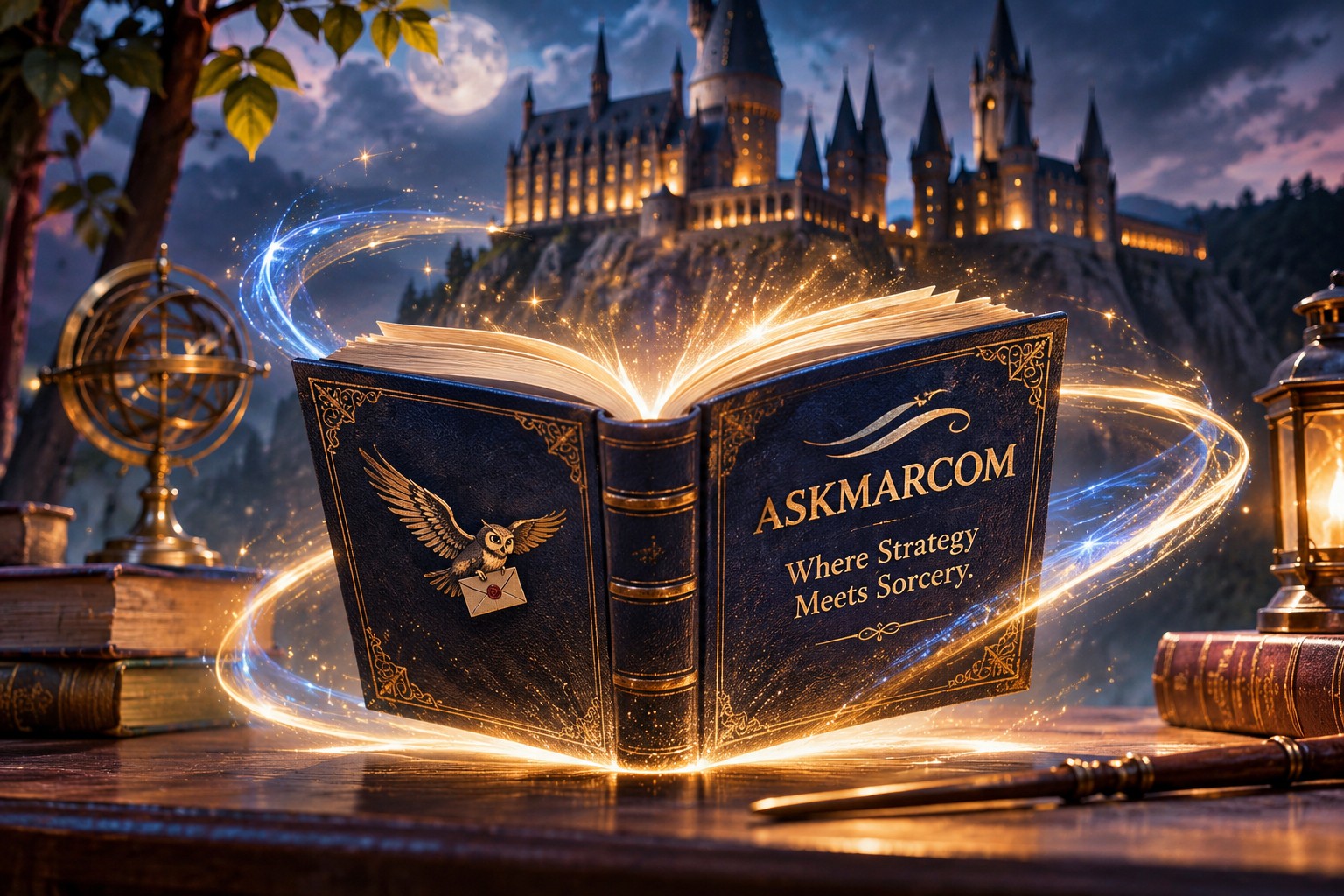
ASKMARCOM / SPECIAL FEATURE
How did a story about a young wizard become a worldwide phenomenon, captivating generations across cultures? The answer is about much more than magic. It is about the extraordinary power of a coherent story, an inhabitable world and an emotional promise that people wanted to return to.
There are books we read, films we watch and stories we remember. And then there are rare fictional worlds that people continue to inhabit long after the final page or closing credits. Harry Potter belongs to that last category.
For millions of readers, Hogwarts was not simply a setting. It was a place they could imagine entering. The houses, the moving staircases, the classes, the friendships, the rivalries, the rules and the rituals gave the world a texture that made it feel larger than the plot. A generation did not merely follow Harry’s adventures. Many grew up alongside him.
A story that travelled far beyond its first page
The first book, Harry Potter and the Philosopher’s Stone, was published in the United Kingdom in 1997. Six further novels followed, concluding with Harry Potter and the Deathly Hallows in 2007. The scale of the readership is extraordinary: the books have sold more than 600 million copies worldwide and have been translated into 85 languages, according to the author’s official site and publisher information. J.K. Rowling’s official bibliography · Bloomsbury’s author profile.
But sales alone do not explain the phenomenon. A large audience can buy a book; a devoted audience builds a relationship with its world. Harry Potter moved from publishing into cinema, theatre, games, consumer products, retail, theme-park experiences and tourism. The franchise’s own official FAQ describes it as a global cultural and commercial enterprise spanning these connected fields. J.K. Rowling’s official franchise FAQ.
That expansion matters because it was not simply a collection of unrelated products carrying the same name. The different formats offered new ways to encounter a recognisable universe. The books supplied the narrative foundation; the films gave its imagined places and characters a shared visual form; stage productions and experiences offered audiences new ways to step closer to the story.
The real achievement: building a world people could enter
World-building is often discussed as a creative technique. In Harry Potter, it became a powerful audience relationship. Hogwarts had an internal logic. Its houses offered identity and belonging. Its objects and traditions carried meaning. Its characters had flaws, loyalties, fears and ambitions. Even the smallest details suggested that the world continued beyond the scene currently being read.
This density of detail invited curiosity. Readers could debate characters, choose a house, revisit clues, develop theories and share interpretations. The story created room for participation without requiring every reader to experience it in exactly the same way.
That is a significant distinction. A brand that only broadcasts a message asks people to receive it. A world with meaning gives people something to explore, interpret and make part of their own lives.
Why it crossed generations and cultures
Harry Potter’s setting is richly specific: British schools, boarding-school traditions, folklore, sport, food, language and a recognisably British sense of place. Yet its central emotional themes are widely legible: friendship, exclusion, courage, grief, loyalty, temptation, prejudice, growing up and the search for belonging.
Readers in different countries did not need identical cultural backgrounds to understand the loneliness of being an outsider, the importance of friendship or the desire to be recognised for who one is. Translation carried the words across languages; the emotional architecture helped the story travel.
Age also became part of the franchise’s unusual reach. Younger readers could experience the wonder, humour, mystery and adventure. Older readers could recognise the moral ambiguity, institutional failure, loss and difficult choices that deepen as the series progresses. Parents and children could share the same story while finding different meanings in it.
The power of growing up with the story
The books arrived over a decade, and the film adaptations unfolded across a similar period. Readers and viewers had time to anticipate each new chapter, revisit earlier ones and discuss what might happen next. The wait became part of the experience.
Each new release renewed attention while the existing books remained available to new readers. Older fans could return; younger audiences could discover the series for the first time. This created a cycle of discovery, anticipation and re-engagement rather than a single moment of launch-day attention.
It also created a shared cultural vocabulary: names, places, objects, phrases and choices that fans could recognise and discuss. The story became social. People did not only consume it privately; they exchanged interpretations, recommendations, memories and rituals around it.
The name on the cover—and the assumptions behind it
There is a revealing publishing story behind the initials J.K. Rowling. The author has explained that her publisher asked her to use initials because they believed the book would appeal to boys and worried that some might not choose a book visibly written by a woman. Rowling’s own account says the “K” was added in honour of her paternal grandmother, Kathleen. Rowling’s account of her story.
So the often-repeated version—that the world discovered only later that the author was a woman—is not quite accurate. Her gender was not a secret that was dramatically revealed after the franchise became famous. The initials were a marketing decision made before publication, based on an assumption about the audience. Rowling later recalled that the disguise did not last long, including after a television appearance. CNN’s 2017 interview transcript.
The episode is still worth examining. It exposes how publishers imagined young readers, how gender assumptions could influence packaging, and how a story’s eventual audience can exceed the narrow expectations formed around it. The work found readers on its own terms, even though the name on its cover had been shaped by a commercial calculation.
A separate identity story came later. In 2013, Rowling was revealed as the author writing the crime novel The Cuckoo’s Calling under the pseudonym Robert Galbraith. That was the genuine pen-name revelation—not the discovery that J.K. Rowling was a woman. The Guardian’s reporting on the Robert Galbraith revelation.
From story to enduring franchise
The Harry Potter universe demonstrates the value of intellectual property with a strong central identity. Its extensions could take different forms, but they remained connected to a recognisable world, its characters and its emotional logic.
That does not mean every extension automatically succeeds, or that commercial expansion is without risk. The more a world grows, the greater the need to protect coherence, quality and audience trust. An extension that feels disconnected can weaken the very meaning that made the original valuable.
The strategic lesson is not simply “create more products”. It is to understand what people value at the heart of the original experience, then decide which new formats genuinely deepen that relationship.
The swirl: why ASKMARCOM chose a visual expression of transformation
This is where the story connects with ASKMARCOM—not because our identity borrows the imagery of Harry Potter, but because the franchise offers a compelling demonstration of a larger principle: imagination becomes powerful when it is given form, structure and meaning.
The flowing swirl on the ASKMARCOM website was chosen to express movement and transformation. It is a visual metaphor for the moment when separate elements begin to come together: a business challenge, a strategic insight, a creative possibility and a clear direction for communication.
Its movement suggests transformation rather than a static symbol. Its ribbons evoke the meeting of disciplines—strategy, creativity, communication and execution. The royal blue, warm ivory and sage tones draw from the ASKMARCOM visual language. The intention is to create a memorable first impression while leaving the substance of the brand firmly rooted in strategic thinking.
The swirl is therefore not a claim that strategy is magic, nor an attempt to imitate a fictional universe. It is an invitation to look beyond the obvious. The animation gives a visual cue to the brand’s creative imagination; the work that follows must earn trust through clarity, judgement and results.
In that sense, the connection is philosophical. Harry Potter shows how a coherent world can turn a story into an experience people want to revisit. ASKMARCOM uses its own visual language to signal the transformation of ideas into purposeful communication. Different scales, different worlds—but a shared respect for the power of imagination when it is shaped with intention.
What businesses can learn from the magic
- Build meaning before multiplying messages. A clear central idea gives every expression of a brand a reason to exist.
- Create a coherent world. Identity, language, behaviour, experience and communication should reinforce one another.
- Make room for participation. People form stronger relationships when they can interpret, discuss and share what a brand represents.
- Respect the emotional dimension. Decisions are not made through information alone. Belonging, trust, aspiration and memory matter.
- Expand with discipline. New channels and experiences should deepen the brand rather than dilute it.
- Understand the audience without underestimating it. Assumptions about who will connect with an idea can be narrower than the audience that ultimately finds it.
The magic is in the meaning
Harry Potter became more than a successful series because it offered more than a sequence of plots. It created a world with emotional depth, internal coherence and enough room for millions of people to find their own point of connection. The books, films and experiences carried that world into new formats, while the story’s central themes continued to invite new generations in.
For brands, the lesson is not to manufacture fantasy. It is to understand what makes an idea worth believing in, remembering and sharing—and then build every expression of that idea with care.
Where Strategy Meets Sorcery.
ASKMARCOM · Brand Strategy | Integrated Communication
Editorial & Intellectual Property Disclaimer
This article is an independent editorial case study celebrating the global cultural impact and commercial success of the Harry Potter franchise. It examines the phenomenon through the perspectives of storytelling, world-building, audience engagement, brand strategy and integrated communication.
All references to Harry Potter, J.K. Rowling and associated characters, names, literary works, films and other intellectual property are made solely for purposes of identification, commentary, criticism and analytical discussion.
All intellectual property rights remain with their respective owners. ASKMARCOM is an independent brand strategy and communication consultancy and is not affiliated with, endorsed by, sponsored by or authorised by J.K. Rowling, Warner Bros. or any associated rights holders.
No ownership of, or claim to, any third-party intellectual property is intended. This article does not seek to reproduce, appropriate or infringe upon any protected rights.
Leave a Reply